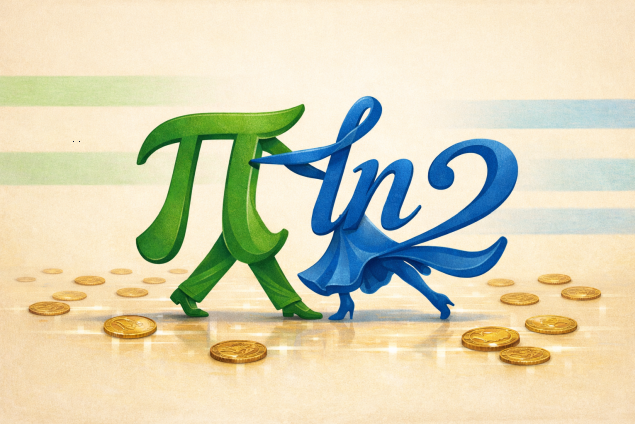
A Transcendental Dance

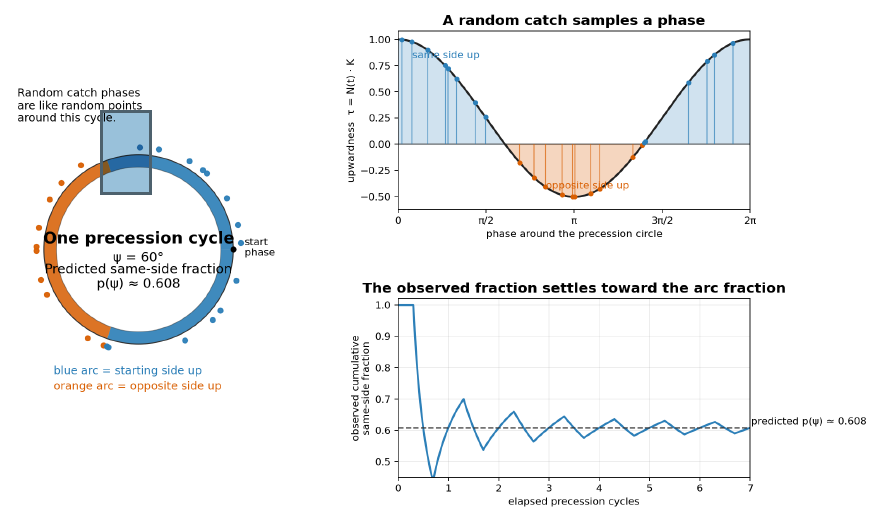
tl;dr: Bruss and Paindaveine did all of this already in December 2025, and better. The initial title of this post was “If This Does Not Blow Your Mind, Nothing Will”, but we didn’t want to be accused of producing clickbait. Still, if this does not blow your mind, nothing will. Hang on to your hats, there are several turns and…

read more

Bayesian Thinking for Toddlers: The Cartoon

For better or for worse, it appears that my most appreciated work is the children’s book Bayesian Thinking for Toddlers (the intro post is here and an exegesis is here). Piled up in my office is a stack of self-printed hardcopies that I hand out to students and colleagues; other than that, the book is not easy to obtain. Maybe…

read more

Redefine Statistical Significance Part XXI: Edgeworth Proposed the .005 Criterion Back in 1885

The statistical significance test was not invented by Ronald Fisher. The key idea was already laid out by Francis Ysidro Edgeworth (1845-1926), whose 1885 article “Methods of statistics” is quite explicit about the purpose, design, and interpretation of the significance test. As summarized by Kennedy-Shaffer: In 1885, Francis Ysidro Edgeworth provided a more formal mathematical underpinning for the significance test…

read more

A Geometric Intuition for the Logarithm

The logarithm is a key concept in mathematics and statistics. Most students will be introduced to the logarithm as the function that is the inverse of exponentiation, or the function that turns multiplication into addition. But without a good intuition of what the logarithm actually is, students can struggle to remember how to compute the logarithm of base r for…

read more

From P-values to Bayes Factors with eJAB

This post is a teaser for Velidi, P., Wei, Z., Kalaria, S. N., Liu, Y., Laumont, C. M., Nelson, B. H., & Nathoo, F. S. (2025). Generalized Jeffreys’s approximate objective Bayes factor: Model-selection consistency, finite-sample accuracy, and statistical evidence in 71,126 clinical trial findings. ArXiv preprint:2510.10358. Abstract “Concerns about the misuse and misinterpretation of p-values and statistical significance have motivated…

read more

“The idea is brilliant and relevant”

A few months ago I submitted a project on open-science for the so-called OSCARS Open Call. Today I received a three-sentence evaluation. The first sentence of the feedback started as follows: “The idea is brilliant and relevant” (and from there it did not go downhill much). Scores on the various dimensions deemed “brilliant and relevant” were 2, 2, 2, 1.5,…

read more

A Chess Scandal Revisited II – Kramnik Responds

Background: Former world chess champion Vladimir Kramnik has argued that several win streaks of Hikaru Nakamura on chess.com are unusually long. Can we analyze these streaks to amass statistical evidence that something fishy is going on? In last week’s blogpost, I argued that the likelihood principle does not license the selection of a particular streak from a longer time series. It…

read more